
Writing clear, detailed NDIS progress notes is one of the most important responsibilities of support workers. Your notes are the official record of care provided, and they directly impact compliance (read our incident reporting guide for related requirements), quality audits, and participant outcomes.
This guide shows you how to write better progress notes with real examples and best practices.
Why NDIS Progress Notes Matter
NDIS progress notes serve three critical purposes:
- Compliance documentation — They prove you’ve delivered the care outlined in the participant’s plan, which is essential for audits and regulatory checks
- Participant safety — Good notes help other team members understand what happened and identify any changes or concerns
- Evidence of quality — Detailed notes show that your organisation is committed to quality care and documentation
According to the NDIS Commission, poor documentation is one of the most common compliance issues providers face. Strong NDIS progress notes protect both the participant and your organisation.
Elements of Strong NDIS Progress Notes
Effective progress notes should include:
- Date, time, and duration of the support session
- Who was present (participant, other staff, family members)
- What activities were completed — be specific (not just “attended appointment” but “attended GP appointment for knee pain assessment; attended for full 60 minutes”)
- How the participant responded — mood, engagement, any changes from normal behaviour
- Any concerns or observations — safeguarding flags, health changes, emotional wellbeing
- Next steps or follow-ups — if applicable
- Participant goals — link the support to their NDIS plan goals
Common Mistakes in Common Progress Note Mistakes (and How to Avoid Them)
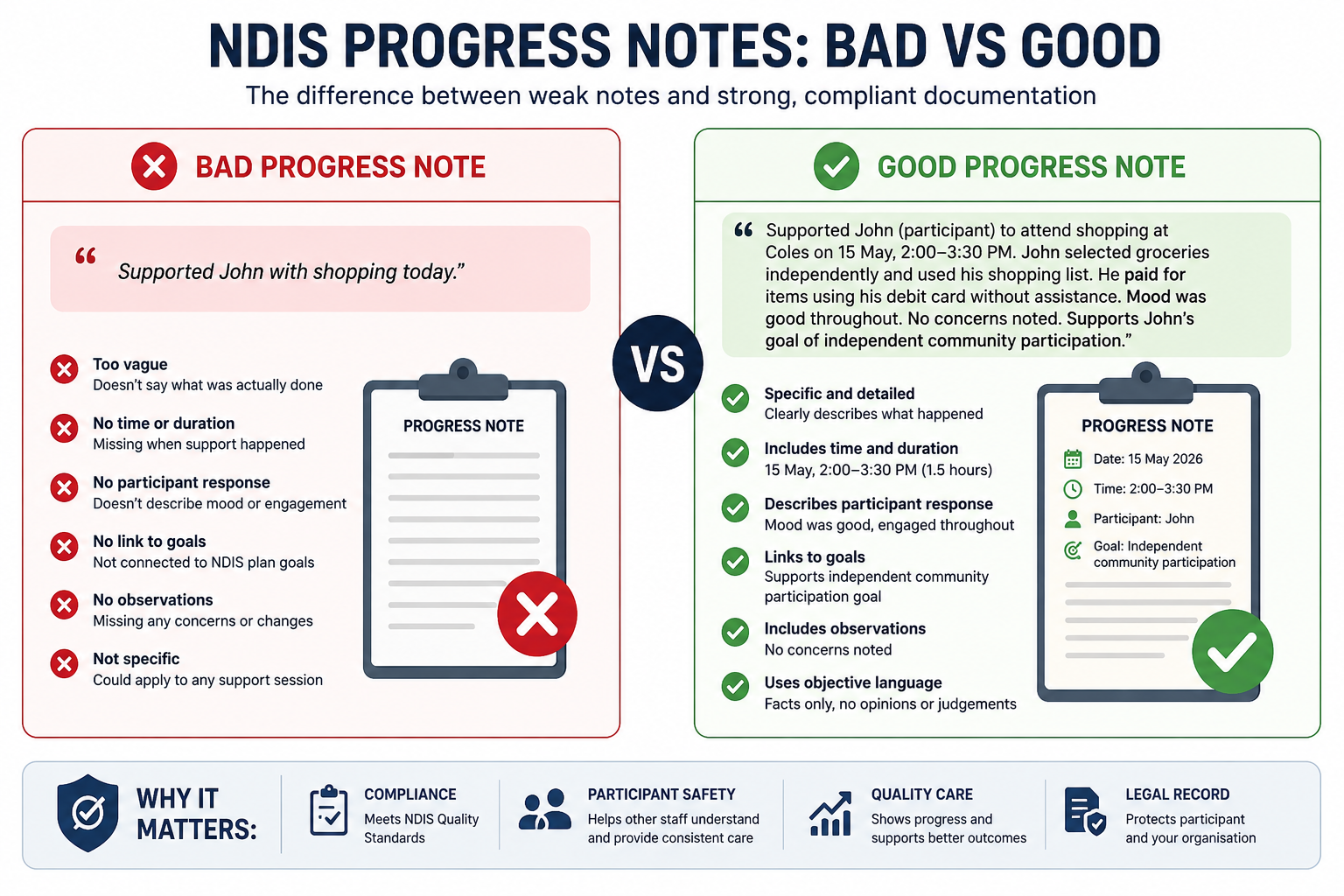
Weak note: “Supported John with shopping today.”
Better note: “Supported John (participant) to attend shopping at Coles on 15 May, 2:00–3:30 PM. John selected groceries independently and used his shopping list. He paid for items using his debit card without assistance. Mood was good throughout. No concerns noted. Supports John’s goal of independent community participation.”
See the difference? The better note is:
- Specific about time and duration
- Shows what the participant did (not just what the worker did)
- Links to a goal
- Includes observation about mood
- Uses objective language
Template for Writing Effective NDIS Progress Notes
Use this structure for consistent, compliant NDIS progress notes:
Date: [Date]
Time: [Start time]–[End time]
Duration: [X hours/minutes]
Participant: [Name]
Support Worker: [Your name]
Activity/Goal: [What was supported, linked to participant’s plan]
What happened: [Objective description of the support provided]
Participant response: [How did they engage, mood, progress toward goal]
Concerns/Observations: [Any changes, safeguarding concerns, health issues]
Next steps: [Any follow-up needed]
Quality Standards for Documentation
The Quality Standards require that providers maintain records that are:
- Accurate and complete
- Made promptly (ideally on the day of support)
- Accessible to the participant
- Stored securely and retained for 5 years (or as specified by law)
Your progress notes must meet all four of these standards. That’s why quality and timeliness matter.
Key Takeaways for Better NDIS Progress Notes
- Be specific — avoid vague language like “support provided” or “had a good day”
- Include dates, times, and durations
- Link every note to a participant goal in their NDIS plan
- Record observations about mood, engagement, and any concerns
- Write promptly — don’t wait days to document
- Use objective language — avoid opinions or judgements
- Remember: your notes are a legal record and may be reviewed by auditors or the NDIS Commission
Well-written progress notes take a few extra minutes to write, but they protect your organisation, support your participants, and make audits easier. Start today.