
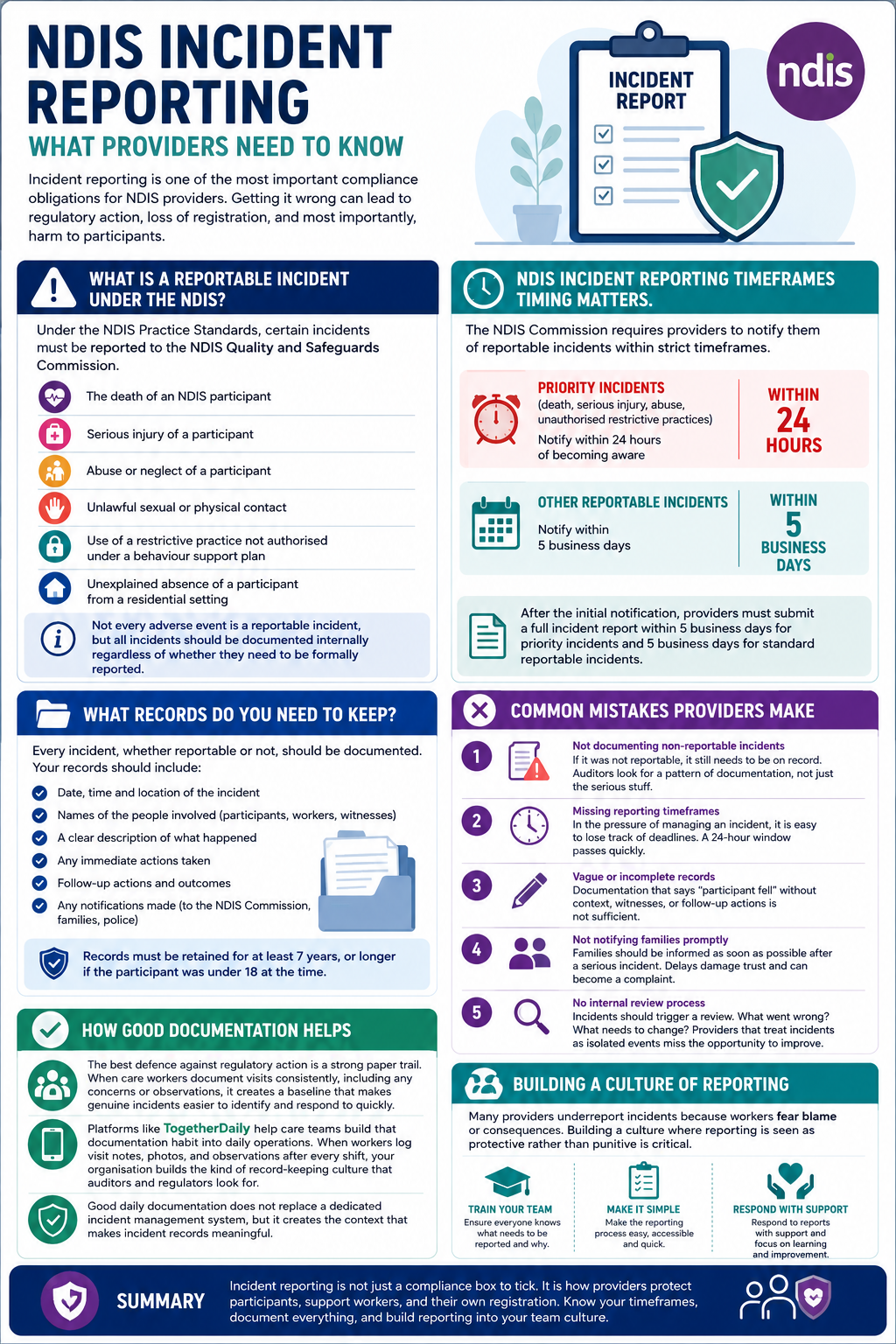
Incident reporting is one of the most important compliance obligations for NDIS providers in Australia. Getting it wrong can lead to regulatory action, loss of registration, and most importantly, harm to participants. This guide explains what providers need to know.
What Is a Reportable Incident Under the NDIS?
Under the NDIS Practice Standards, certain incidents must be reported to the NDIS Quality and Safeguards Commission. These are called reportable incidents and they include:
- The death of an NDIS participant
- Serious injury of a participant
- Abuse or neglect of a participant
- Unlawful sexual or physical contact
- Use of a restrictive practice not authorised under a behaviour support plan
- Unexplained absence of a participant from a residential setting
Not every adverse event is a reportable incident, but all incidents should be documented internally regardless of whether they need to be formally reported.
NDIS Incident Reporting Timeframes
Timing matters. The NDIS Commission requires providers to notify them of reportable incidents within strict timeframes:
- Priority incidents (death, serious injury, abuse, unauthorised restrictive practices): notify within 24 hours of becoming aware
- Other reportable incidents: notify within 5 business days
After the initial notification, providers must submit a full incident report within 5 business days for priority incidents and 5 business days for standard reportable incidents.
What Records Do You Need to Keep?
Every incident, whether reportable or not, should be documented. Your records should include:
- Date, time and location of the incident
- Names of the people involved (participants, workers, witnesses)
- A clear description of what happened
- Any immediate actions taken
- Follow-up actions and outcomes
- Any notifications made (to the NDIS Commission, families, police)
Records must be retained for at least 7 years, or longer if the participant was under 18 at the time.
Common Mistakes Providers Make
1. Not documenting non-reportable incidents
If it was not reportable, it still needs to be on record. Auditors look for a pattern of documentation, not just the serious stuff.
2. Missing reporting timeframes
In the pressure of managing an incident, it is easy to lose track of deadlines. A 24-hour window passes quickly.
3. Vague or incomplete records
Documentation that says “participant fell” without context, witnesses, or follow-up actions is not sufficient.
4. Not notifying families promptly
Families should be informed as soon as possible after a serious incident. Delays damage trust and can become a complaint.
5. No internal review process
Incidents should trigger a review. What went wrong? What needs to change? Providers that treat incidents as isolated events miss the opportunity to improve.
How Good Documentation Helps
The best defence against regulatory action is a strong paper trail. When care workers document visits consistently, including any concerns or observations, it creates a baseline that makes genuine incidents easier to identify and respond to quickly.
Platforms like TogetherDaily help care teams build that documentation habit into daily operations. When workers log visit notes, photos, and observations after every shift, your organisation builds the kind of record-keeping culture that auditors and regulators look for.
Good daily documentation does not replace a dedicated incident management system, but it creates the context that makes incident records meaningful.
Building a Culture of Reporting
Many providers underreport incidents because workers fear blame or consequences. Building a culture where reporting is seen as protective rather than punitive is critical.
That means training your team on what needs to be reported, making the reporting process as simple as possible, and responding to reports with support rather than punishment.
Summary
Incident reporting is not just a compliance box to tick. It is how providers protect participants, support workers, and their own registration. Know your timeframes, document everything, and build reporting into your team culture.
Want to improve your team’s documentation habits?
TogetherDaily helps NDIS and aged care providers build consistent, audit-ready documentation into every shift.